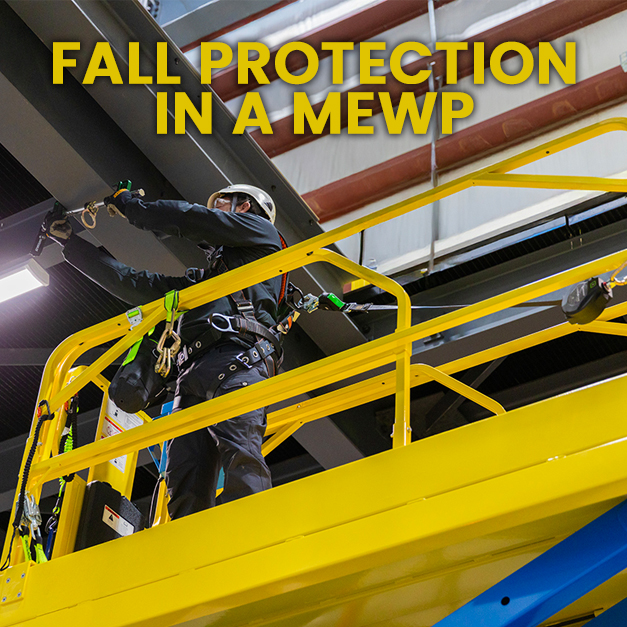
Mobile Elevated Work Platforms (MEWPs), also known as aerial lifts, include boom lifts, cherry pickers and scissor lifts, all of which are essential safety equipment when working at height. At the same time, use of a MEWP creates its own unique fall hazards and questions regarding fall protection equipment use.
How should a fall protection connector such as a lanyard or self-retracting lifeline (SRL) be properly connected while working on an aerial lift? This is a frequent question that both safety equipment manufacturers and safety professionals receive. The answer for “how to connect the connector” depends on the type and design of the fall protection equipment itself. Additionally, the overall use of fall protection in MEWPs is a complex topic and specific regulatory requirements plus the configuration of the fall arrest system or fall restraint system play an integral part as well.
Understanding Fall Hazards in MEWPs
One of the leading causes of serious injuries and fatalities in construction and industrial environments are falls from elevation. In MEWPs, however, ejection from the platform remains the primary fall hazard. This is often caused by improper use of fall protection, uneven terrain (remember the “mobile” part of MEWP), contact with external objects or equipment failure.
The Occupational Safety and Health Administration (OSHA) recognizes the risks working from MEWPs and requires the use of fall protection when exposed to such hazards. Some vertical-only lifts with guardrails do not require personal fall protection equipment through OSHA, however, the lift manufacturer guidelines or specific jobsite rules may dictate the use of fall protection on all MEWPs no matter the type.
OSHA Requirements for Fall Protection in Aerial Lifts
A worker in a lift must follow the ABCs of fall protection: [1] Anchored at all times to an engineered anchor point that is designed into the MEWP; [2] Fitted with a full body harness; [3] Secured with an appropriate connector such as a lanyard or SRL. As with all fall protection systems, proper fall clearance must be calculated for the specific application.
Using all three components, OSHA requires the use of either one of two appropriate systems as necessary fall protection, depending on use and type of the lift. A fall restraint system is always required when the MEWP is in motion to prevent the worker from being ejected. A personal fall arrest systems is required to protect a worker from serios harm and facilitate rescue after a fall from the lift occurs.
- For fall restraint in MEWPs, a fixed length or adjustable lanyard is used to create a restraint system while the lift is moving. These lanyards are attached to the side positioning D-rings of the harness. They do not have an energy absorber as they are not meant to be used in a fall. When properly worn, a restraint lanyard serves to both prevent the worker from reaching a position where a fall could occur and keep the worker within the lift in case of a sudden stop or tipping event.
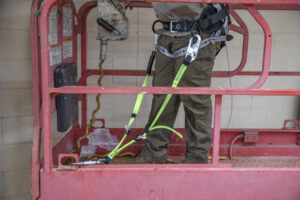
- For fall arrest, energy-absorbing lanyards and SRLs should be used in MEWPs. Fall clearance must be calculated to ensure the proper length device is being utilized. When using an SRL, either a Class 1 or Class 2 device can be used depending on whether the anchor is below D-ring (Class 2 ) or above (Class 1 or Class 2). If the line constituent of the lanyard or SRL may come in contact with a sharp edge, a lanyard made with suitable line material as used in a Class 2 SRL is required.
- Note that other regulatory agencies (such as ANSI) and other guidelines (such as EM385 from the Army Corps of Engineers) have differing requirements. Individual companies and specific jobsites may also have additional safety requirements.
How Should the Fall Protection Connector Be Attached?
In any aerial lift, as with any fall protection system, the connector joins the harness and the anchor.
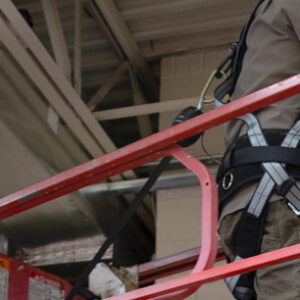
- One end of the lanyard or SRL connects to the dorsal D-ring of a full body harness – that’s the ring on the back between the shoulder blades. This allows forces to be evenly distributed across a worker and minimize injury in the event of a fall.
- The other end of the lanyard or SRL must connect to a rated fall protection anchor point. OSHA requires that workers in aerial lifts anchor their fall protection to the lift itself, not to adjacent structures or guardrails. Guardrails, mid-rails or toe boards are not designed for supporting fall arrest forces and should never be used as anchor points.
But Which End Connects Where?
This seems to be one of the most confusing questions about connecting lanyards and SRLs in a MEWP to create a safe fall arrest system. This is in part because there is no easy “one size fits all” answer. One end of the connector attaches to the dorsal D-ring of the harness, and the other end connects to the anchor point. But which end goes where? At a base level, the clearest answer is to consult the manufacturer guidelines for the specific equipment.
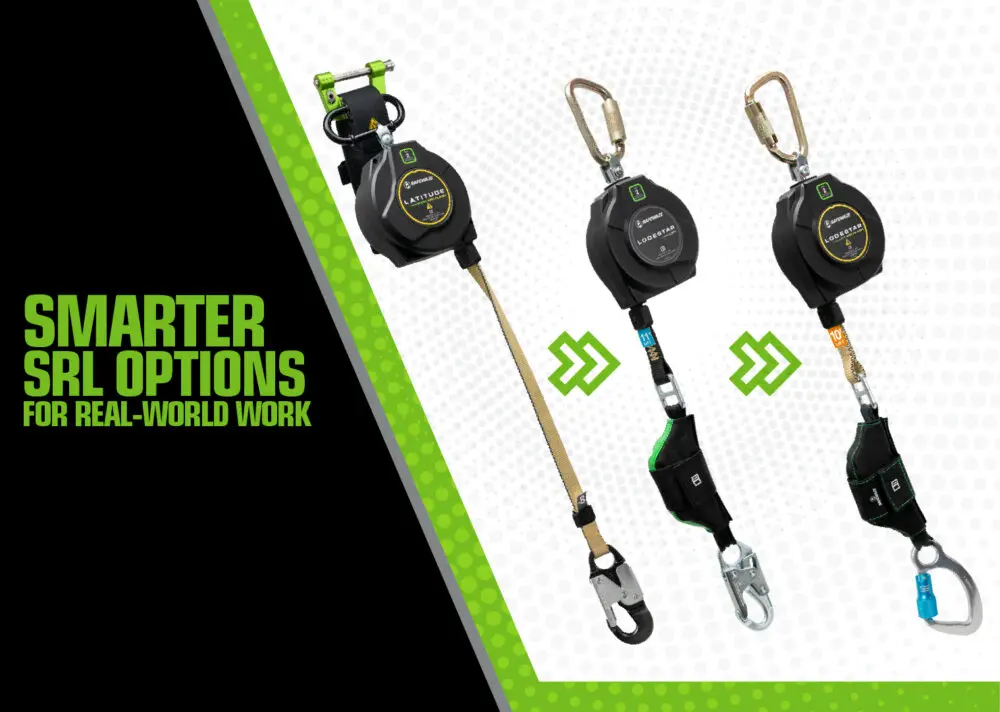
A connector that is especially made for use in an aerial lift, such as the Lodestar Lift, makes it easy with a high-visibility warning label to ensure proper anchor point connection.
Additionally, it will help to remember that the energy-absorbing portion of the connector attaches closest to the worker for any lanyard or SRL used in a fall arrest system on a MEWP.
- When there is an external energy-absorber such as a shock pack, the end with the energy-absorbing shock pack attaches to the dorsal D-ring of the harness. The shock pack can be at either end of the SRL or lanyard so it is important to understand where the shock pack is located on the connector before use in a MEWP.
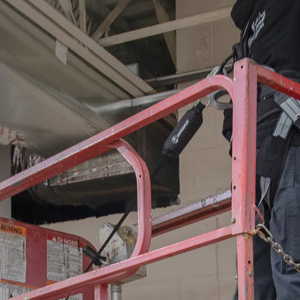
- With an SRL-P, there may be an internal energy-absorber such as the braking system within the SRL housing that eliminates the need for a shock pack. In this case, the end with the housing attaches to the dorsal D-ring of the harness.
Key Takeaways for Fall Protection in MEWPs
- Proper training, equipment selection and setup are essential for reducing fall risks in any form of MEWP.
- Both OSHA and ANSI require a fall restraint system whenever a MEWP is in motion to prevent ejection. Restraint is widely recognized as the preferred form of fall protection in lifts.
- A fall arrest system with proper fall clearance is required by OSHA and ANSI on most MEWPS and may also be required by the lift manufacturer or jobsite governance.
- The energy-absorbing portion of the connecting device attaches closest to the worker for any fall arrest lanyard or SRL.